29 avril 2026
Times Higher Education 2026 Rankings: An Unprecedented Top Three and a Changing Academic Landscape
Every fall, the academic world eagerly awaits this moment: the release of the Times Higher Education World University Rankings.
The 2026 edition upsets the balance in some areas: while Oxford retains its crown, the (Massachusetts Institute of Technology) takes second place, while Princeton and Cambridge share third place ex aequo — a first in over a decade.
Behind this historic podium, the rankings reveal profound shifts: Asia’s continued rise, the United States’ decline, and the visibility challenges facing French universities.
For high school and college students aiming for an international career, understanding this ranking is essential.
👉 At Academica Dual Diploma, we specifically help students develop bilingual skills and a global academic outlook—assets that are directly valued in these rankings.
The THE Rankings: A Global Barometer of Excellence
Created by the British media outlet Times Higher Education (THE), this ranking evaluates more than 2,191 universities from 115 countries.
Five major weighted criteria serve as the basis for the evaluation:
- Teaching (29.5%): academic reputation, supervision, learning environment.
- Research (29%): volume, funding, and reputation.
- Citations (30%): scientific influence and global impact.
- Internationalization (7.5%): proportion of international students and faculty.
- Industry relations (4%): innovation, technology transfer, and economic partnerships.
👉 These criteria are detailed in the official THE 2026 methodology
The top 10 with a historic podium
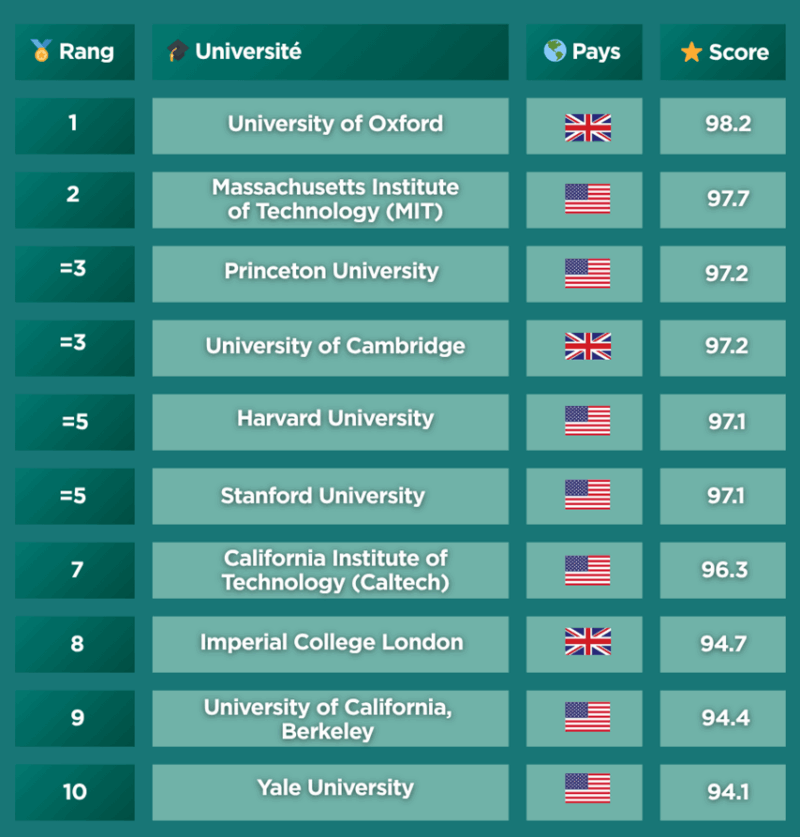
Top 10 Global Universities – THE 2026 Rankings
The THE 2026 Rankings rank:
1️⃣ University of Oxford
2️⃣ Massachusetts Institute of Technology (MIT)
3️⃣ tied: Princeton and Cambridge
These results reflect a restored balance between the United Kingdom and the United States, with the two countries alone occupying eight of the top ten spots worldwide.
However, in previous years’ rankings (2022–2025), the United States dominated by a wide margin: Harvard, Stanford, MIT and other American institutions occupied almost the entire top of the table, with Oxford often being the only British university to compete on a sustained basis.
In 2026, the combined presence of Oxford (1st), MIT (2nd), Princeton and Cambridge (tied for 3rd) thus marks a new balance between the two historic academic powerhouses.
Just outside the top 10, Tsinghua University (12th), in China, confirms Asia’s rising influence in global higher education.
Oxford Unbeatable: The Supremacy of the British Model
For the tenth consecutive year, the University of Oxford retains the top spot worldwide.
It leads the pack thanks to exceptional research quality (97.7 / 100) and a stable academic environment, despite the post-Brexit context.
France: structural progress, but fragile global visibility
France maintains a solid presence but struggles to climb back into the top 50:
- PSL (Paris Sciences et Lettres): 48th (down from 42nd in 2025)
- Institut Polytechnique de Paris has moved up slightly (+3 places compared to 2025) but remains outside the Top 50 (68th)
- Paris-Saclay University: 68th
- Sorbonne University : 76th
These rankings, resulting from the recent consolidation of French universities, reflect a qualitative improvement, but a lag in internationalization and funding remains.
University consortia (PSL, Paris-Saclay, Côte d’Azur) help to enhance the French system’s visibility internationally.
Why this fragility?
Several analyses highlight structurally weaker R&D resources in France compared to its main competitors, a complex organization of the university system that can hinder efficiency, and lower international appeal for certain types of researchers—all factors cited as obstacles to progress in the rankings.
United States: The End of Absolute Hegemony?
The United States remains the most represented country in the clasTHE 2026 rankings, with 171 universities ranked, compared to 174 last year.
The country retains a dominant position, but the trend toward slowdown is confirmed. THE’s press release notes that “the US continues to decline overall.”
While it still dominates the top 500 with 102 institutions, this is the lowest number ever recorded, and 25 American universities achieved their worst-ever results.
Notably, Princeton University posted the best performance in its history, reaching a tied 3rd place, while Harvard drops to 5th and Columbia drops to 20th.
Why this change?
Various analyses suggest several factors:
- The high cost of American education, among the highest in the world, could limit international diversity.
- Increased competition from Asia and the United Kingdom, whose universities are advancing rapidly; the official press release from THE states that “Asia continues its rapid progress.”
- A post-pandemic slowdown in mobility: in 2024, 42% of U.S. universities reported a decline in international student enrollment.
Despite this decline, the United States retains unparalleled research and innovation capabilities, supported by R&D budgets and university-industry partnerships that are unmatched worldwide.
The Asian Rise: Singapore and China at the Forefront
Tsinghua University (12th), Peking University (13th) and the National University of Singapore (17th) are all three ranked in the global top 20 of the Times Higher Education 2026.
They embody the steady rise of Asian universities, driven by significant public investment and ambitious internationalization strategies.
This performance confirms that Asia is no longer merely an academic “outsider”: its institutions now rival historic American and British universities in both research quality and education.
Chinese universities, particularly Tsinghua and Peking, stand out with scores close to 100 in research and industry collaboration, while the National University of Singapore boasts one of the highest internationalization rates in the ranking (92.8).
What this means for Dual Diploma students
For students in the French Baccalaureate who are also preparing for the U.S. High School Diploma, this ranking highlights:
- Expanded opportunities: academic excellence is no longer limited to the US-UK axis.
- An increased value of the bilingual and international profile, sought after in all areas of the top 50.
- A need to evaluate each university based on its specific focus: a student interested in biology, for example, will find excellent programs in Singapore, the Netherlands, or Canada, beyond the traditional Harvard-Oxford-Cambridge trio.
This data confirms the value of a dual degree: it opens the doors to all major university systems, regardless of the continent.
Rankings: an indicator, not an absolute truth
Rankings measure overall performance, but not necessarily the fit between a student and a university.
A university ranked 100th may offer a better student experience, support, or employment rate than some institutions in the top 20.
Experts emphasize that it is essential to cross-reference multiple sources:
- Times Higher Education (THE), which primarily evaluates research, teaching, and internationalization ;
- QS World University Rankings, more focused on reputation and employability ;
- Shanghai Ranking, which primarily measures scientific output and Nobel Prizes ;
- as well as employment statistics, exchange programs, and scholarships.
These different methodologies explain why, for example, Oxford may be 1st in THE but 4th in QS: each ranking examines a distinct aspect of academic excellence.
Toward a multipolar academic world
The 2026 THE rankings mark a new era for global academic competition:
- The United Kingdom strengthens its leadership, with Oxford and Cambridge firmly entrenched at the top.
- The United States sees its dominance stabilize, but remains a major scientific and technological leader.
- Asia is now establishing itself as a key player in global academic excellence.
For students in the Dual Diploma program, this is excellent news: their dual academic and linguistic background aligns perfectly with this international openness of higher education systems. It ideally prepares them to take advantage of the many opportunities for academic exchange, such as the Erasmus programs or semesters abroad, which have become key milestones in a globally oriented academic journey.
The key message: beyond a university’s ranking, it is the alignment between your goals, your personality, and your international ambition that will make the difference.
🎓 Want to learn more about the Dual Diploma?
Discover how our program helps middle and high school students build a bilingual and globally-minded profile, to gain admission to prestigious schools and universities that suit them, both in France and internationally → dualdiploma.org
🔎 Sources
- Times Higher Education – World University Rankings 2026: Methodology Explained
- Times Higher Education – World University Rankings 2026: Full Results
- Times Higher Education – Press Release: World University Rankings 2026 Out Now
- Times Higher Education – US Universities’ International Recruitment Back in Reverse
- SecureMyScholarship – The Cost of Studying in the US
- QS World University Rankings 2025 – Official Ranking
- Shanghai Ranking (ARWU) 2025 – Global Ranking of Academic Subjects
Classement Times Higher Education 2026 : un podium inédit et un monde universitaire en recomposition
Lire la suite

D’Anglais I à Anglais V : le parcours linguistique après le test de niveau du Dual Diploma
Lire la suite

Academica et le Réseau mlfmonde s’unissent pour élargir l’horizon des élèves
Lire la suite